
Flu Season in El Paso: Why Getting Your Flu Shot This Year Is More Important Than Ever
Flu Season in El Paso: Why Getting Your Flu Shot This Year Is More Important Than Ever
Every year as temperatures begin to drop across El Paso, TX, influenza quietly begins its seasonal spread through our community. While many people dismiss the flu as a minor inconvenience, the reality is far more serious—and for certain populations, the flu can be life-threatening. At Kingsway Medical Center on North Loop Dr, we see the devastating consequences of influenza every single season, and we are committed to helping every family in our community understand why the annual flu vaccine is one of the simplest yet most powerful steps you can take to protect yourself and your loved ones.
Dr. Adekunle Adedeji, who holds dual board certifications in Family Medicine and Geriatric Medicine, emphasizes that flu vaccination is not just an individual health decision—it is a community health responsibility. When you get vaccinated, you protect not only yourself but also the vulnerable people around you who may not be able to fight the infection on their own: your elderly parents, your young children, and your neighbors managing chronic disease.
In this guide, we will examine what makes this flu season particularly important, explore who is at highest risk, debunk persistent flu vaccine myths, and explain exactly what you can expect when you visit Kingsway Medical Center for your 2026 flu shot.
Table of Contents
- Understanding Influenza: More Than Just a Bad Cold
- Why El Paso Is Uniquely Vulnerable During Flu Season
- Who Needs the Flu Vaccine Most? High-Risk Populations
- How the Flu Vaccine Works: Science Made Simple
- Debunking Flu Vaccine Myths Once and For All
- The 2026 Flu Season: What Experts Are Predicting
- Protecting Seniors: The Geriatric Flu Care Difference
- What to Expect When You Get Your Flu Shot at Kingsway
- Frequently Asked Questions (People Also Ask)
- Get Your Flu Shot at Kingsway Medical Center Today
1. Understanding Influenza: More Than Just a Bad Cold
One of the most dangerous misconceptions in public health is the belief that the flu is simply a severe cold. Influenza and the common cold are caused by entirely different families of viruses, and their consequences are drastically different.
The common cold is typically caused by rhinoviruses. Symptoms are generally mild—runny nose, sneezing, mild cough—and most people recover within 7-10 days without any medical intervention.
Influenza is caused by influenza A or B viruses. It attacks the respiratory system aggressively, producing sudden onset of high fever (often 101-104°F), severe body aches, intense fatigue, dry cough, and headache. Unlike a cold, the flu can rapidly progress to life-threatening complications including pneumonia, myocarditis (inflammation of the heart), encephalitis (brain inflammation), and multi-organ failure.
According to the Centers for Disease Control and Prevention (CDC), influenza is responsible for between 12,000 and 52,000 deaths annually in the United States, along with hundreds of thousands of hospitalizations. These are not abstract statistics—they represent real families in communities like ours.
2. Why El Paso Is Uniquely Vulnerable During Flu Season
El Paso's position on the U.S.-Mexico border and its demographic profile create several factors that amplify flu season impact in our community:
Cross-Border Population Flow: El Paso and Ciudad Juárez form one of the largest binational metropolitan areas in the world. Daily cross-border commuting for work, school, and family visits creates a massive corridor for viral transmission that does not respect national boundaries.
High Rates of Chronic Disease: Our community experiences elevated rates of Type 2 diabetes, hypertension, obesity, and asthma—all conditions that dramatically increase the risk of severe flu complications. For more on managing these conditions, see our guide on diabetes management in El Paso.
Multi-Generational Households: Many El Paso families live in homes with grandparents, parents, and children under one roof. While this cultural strength builds family bonds, it also means that a child who brings the flu home from school can rapidly expose vulnerable elderly family members.
Vaccination Hesitancy: Misinformation about flu vaccines continues to circulate in our community, leading to lower vaccination rates than the national average. This creates pockets of vulnerability where outbreaks can take hold more easily.
In our practice at Kingsway Medical Center, we address these challenges head-on with culturally sensitive, bilingual education and convenient walk-in vaccination services designed to meet our community where it is.
3. Who Needs the Flu Vaccine Most? High-Risk Populations
While the CDC recommends annual flu vaccination for everyone aged 6 months and older, certain populations face dramatically higher risk of severe complications and should absolutely prioritize getting vaccinated:
- Adults 65 and older — Immune systems naturally weaken with age (immunosenescence), making seniors far more susceptible to severe infection. Approximately 70-85% of flu-related deaths occur in people 65+.
- Children under 5 years old — Particularly those under 2, whose immune systems are still developing.
- Pregnant women — Flu during pregnancy increases the risk of premature birth, low birth weight, and hospitalization.
- People with chronic conditions — Diabetes, heart disease, asthma, COPD, kidney disease, liver disease, and immunocompromising conditions all amplify flu severity.
- Healthcare workers and caregivers — Those in close contact with vulnerable individuals must be vaccinated to prevent becoming vectors of transmission.
- Residents of nursing homes or long-term care facilities — Close-quarters living dramatically increases transmission risk.
Key takeaway: If you fall into any of these categories—or if you live with someone who does—getting vaccinated is not optional. It is a medical necessity.
4. How the Flu Vaccine Works: Science Made Simple
The flu vaccine works by introducing your immune system to inactivated (killed) or weakened flu virus proteins. Your body cannot get the flu from the vaccine—this is biologically impossible with modern inactivated vaccines.
Here is the process in simple terms:
Step 1: Introduction. The vaccine exposes your immune system to specific flu virus surface proteins called hemagglutinin (the "H" in H1N1) and neuraminidase (the "N").
Step 2: Immune Response. Your body recognizes these proteins as foreign and mounts an immune response, producing antibodies specifically designed to neutralize those flu strains.
Step 3: Memory. Your immune system creates memory cells that remember the flu virus. If you are later exposed to the actual flu virus, your body can recognize and fight it immediately—before the infection takes hold.
Step 4: Protection. Full protection develops approximately 2 weeks after vaccination. This is why health authorities recommend getting vaccinated early in the season—ideally by the end of October—before flu activity peaks.
The World Health Organization (WHO) coordinates global surveillance to predict which flu strains will circulate each season, and the vaccine formulation is updated annually to match.
5. Debunking Flu Vaccine Myths Once and For All
Dr. Adedeji often encounters the same misconceptions about flu vaccines in our clinic. Let us address them directly with medical evidence:
MYTH: "The flu shot gave me the flu." FACT: The injectable flu vaccine contains inactivated virus—it cannot cause influenza. Mild side effects like arm soreness, low-grade fever, or fatigue for 1-2 days are normal immune responses, not the flu. If you got sick shortly after vaccination, you were either already incubating the virus or caught a different respiratory illness.
MYTH: "I'm healthy, so I don't need it." FACT: Healthy adults can and do die from influenza. Additionally, healthy people who carry the flu often spread it to vulnerable family members and coworkers before they even realize they are sick. Vaccination protects your entire circle.
MYTH: "The flu vaccine doesn't work because I still got sick." FACT: No vaccine is 100% effective. However, even when the vaccine does not completely prevent infection, it significantly reduces the severity of illness, shortens recovery time, and dramatically reduces the risk of hospitalization and death. A vaccinated person who catches the flu is far less likely to end up in the ICU.
MYTH: "I got the shot last year, so I'm still covered." FACT: Flu viruses mutate rapidly through a process called antigenic drift. Each year's vaccine is reformulated to match the predicted circulating strains. Last year's antibodies may not effectively neutralize this year's virus. Annual vaccination is essential.
6. The 2026 Flu Season: What Experts Are Predicting
Based on surveillance data from the Southern Hemisphere's winter season (which precedes ours), health authorities are anticipating an active 2026-2027 flu season in the United States. Key predictions include:
- Predominant Strains: Influenza A (H1N1 and H3N2) variants are expected to dominate, with some Influenza B activity.
- Timing: Peak flu activity in the El Paso region is typically observed between December and February, though cases can begin appearing as early as October.
- Severity: The combination of circulating strains and residual immunity patterns suggests a moderate-to-severe season, particularly for older adults and those with comorbidities.
The CDC's updated 2026-2027 vaccine formulation includes protection against the most current variants. Getting vaccinated as early as possible—ideally in September or October—maximizes your protection window before peak activity arrives.
7. Protecting Seniors: The Geriatric Flu Care Difference
For adults aged 65 and older, standard flu vaccination may not provide sufficient protection due to age-related immune decline. At Kingsway Medical Center, Dr. Adedeji's geriatric expertise ensures our senior patients receive the most appropriate vaccination strategy.
High-Dose and Adjuvanted Vaccines: The CDC specifically recommends that adults 65+ receive either the high-dose flu vaccine (Fluzone High-Dose) or an adjuvanted vaccine (Fluad), both of which produce a stronger immune response than the standard-dose shot.
Pneumonia Co-Vaccination: Influenza in seniors frequently progresses to bacterial pneumonia. We often recommend that eligible seniors receive both the flu vaccine and the pneumococcal vaccine to provide comprehensive respiratory protection.
Medication Interaction Review: Before administering any vaccine, we review our senior patients' current medications to identify any potential interactions or contraindications—a standard part of comprehensive geriatric care. For more on how we protect our senior patients, visit our article on preventative care for aging adults.
8. What to Expect When You Get Your Flu Shot at Kingsway
Getting your flu shot at Kingsway Medical Center is quick, convenient, and comfortable:
- Walk-ins welcome — No appointment necessary during flu season.
- The process takes approximately 15-20 minutes, including a brief health screening and the vaccination itself.
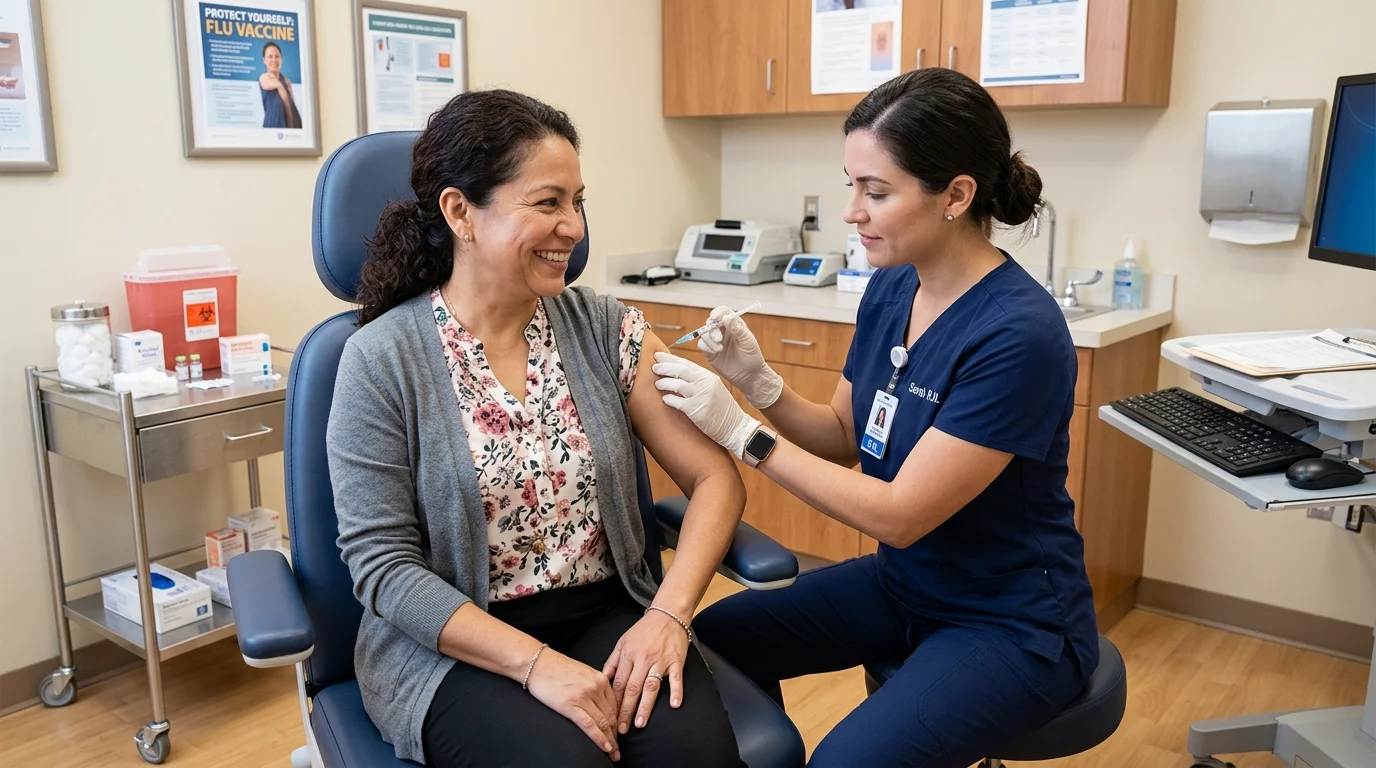
- The injection is given in the upper arm muscle (deltoid). Most patients describe it as a brief pinch lasting less than a second.
- Observation period — We ask you to remain in the clinic for 15 minutes after vaccination to monitor for any rare allergic reactions.
- Common mild side effects include arm soreness at the injection site (1-2 days), mild fatigue, or slight low-grade fever. These are signs your immune system is working.
Our bilingual staff is available to answer any questions in English or Spanish, and we accept most major insurance plans. For uninsured patients, we offer affordable cash-pay options.
9. Frequently Asked Questions (People Also Ask)
When is the best time to get the flu shot? The CDC recommends getting vaccinated by the end of October. However, getting vaccinated any time during flu season still provides benefit. At Kingsway Medical Center, we begin offering flu shots in September and continue throughout the season.
Can I get the flu shot if I have an egg allergy? Yes. While most flu vaccines are produced using egg-based technology, the amount of egg protein in modern vaccines is extremely small. The CDC states that people with egg allergies of any severity can receive any age-appropriate flu vaccine. Egg-free vaccine options (Flucelvax, Flublok) are also available for those who prefer them.
Is it safe to get the flu shot while pregnant? Absolutely. The flu shot (inactivated vaccine) is not only safe during pregnancy—it is strongly recommended. Vaccination protects both the mother and the newborn baby during the first few months of life before the infant is old enough to be vaccinated.
How effective is the flu vaccine? Effectiveness varies by season depending on how well the vaccine matches circulating strains. In well-matched seasons, the flu vaccine reduces the risk of illness by 40-60%. Even in less well-matched years, vaccination still provides significant protection against severe illness and hospitalization.
Watch: Why the Flu Vaccine Matters
For a clear, visual explanation of how the flu vaccine protects you and your family, watch this educational video:
10. Get Your Flu Shot at Kingsway Medical Center Today
Do not wait for flu season to be in full swing before taking action. The best time to get vaccinated is now—before the virus begins circulating widely in El Paso and the surrounding communities.
Whether you need a standard flu shot for your family, a high-dose vaccine for an elderly parent, or guidance on protecting a loved one with chronic health conditions, the team at Kingsway Medical Center is ready to help. Contact us today or schedule an appointment online. Walk-ins are also welcome—just visit us at 8623 North Loop Dr, El Paso, TX 79907 or call (915) 881-4155.
Disclaimer: The information provided in this article and any accompanying videos is for educational purposes only and is not intended to be a substitute for professional medical advice, diagnosis, or treatment. Always seek the advice of your physician or other qualified health provider at Kingsway Medical Center with any questions you may have regarding a medical condition or diet changes.
Need to see a doctor?
Our bilingual team is ready to provide compassionate care for your family.
Schedule an Appointment